Religion~ We continued our discussion of The 10 Commandments. We focused on the 2nd Commandment, "You shall not take the name of the Lord your God in vain." We talked about how we only use the name of God to speak to him or about him in a reverent way. We stressed that we should never use the name of God in anger!
History~ We learned more about the ancient Egyptians. We talked about the ancient kingdom of Kush (Nubia). We learned that Nubia means the land of gold. Nubia was a land of natural wealth. They had gold mines, iron ore, ivory, and incense. All of these were great for trading. The Nubians were excellent archers which kept them safe for many years. We discussed what their daily life was like, what they would eat, what they would wear, and why their kingdom began to weaken. The Nubians were Africans, so we created a hand painting(drawing) using geometric designs which is an African tradition that dates back to ancient times. . Each child was given a map of the Egyptian empire that included Nubia. They can color this at home if they would like. A wonderful book to read that goes along with this lesson is Anansi the Spider by Gerald McDermott. Our local library does have the book for those interested.
Poetry~ We talked about the second stanza of The Frog by Hillaire Belloc. Three of the children were able to recite the first stanza. A great job goes out to J. Spiering, J. Pullen, and M. Gilkison.
English~ We did Lesson 37 this week. We learning when to use has or have. The kids found this very easy. We actually finished English early, which is a big change for us!
Music~ The kids agreed to perform a round of Are You Sleeping? for the Saint Nicholas party.
Science~ The kids were excited for the visit from Ranger Jennifer. They enjoyed seeing the turtles, toads, and snakes. The kids were eager to touch and everyone shared plenty of information. At the end of the presentation, all the children watched the box turtle walk around. He headed for the glass doors. He either wanted to head outdoors or escape the herd of children following behind. As we ended our day, the children unanimously voted the baby turtles as their favorite animal.
Hope everyone has a wonderful Thanksgiving with their families!
Showing posts with label Year One. Show all posts
Showing posts with label Year One. Show all posts
Tuesday, November 13, 2012

Tuesday, March 27, 2012
Music to learn (CSH Recommended)
#1 Salve Regina -The Lyrics and Melody as Sung Below:
#2 O Sanctissima - Lyrics to Print: O Sanctissima
The Melody as Sung Below:
#3 Regina Caeli Laetare - The Lyrics and Melody as Sung Below:
Thursday, March 15, 2012
Science, Week 20 with Catholic Schoolhouse Curriculum
 This week's experiment was not successful, but I think that very fact drove home the reality of the word "experiment." The children were to try to light a light bulb using only potatoes, nails, and leads. Next to the lightening experiment during our quarter on weather, this was probably the most exciting day yet in science. Thanks to Catholic Schoolhouse's Science Curriculum for suggesting the activity! The students all banned together to light the light bulb, and they were full of ideas and excitement. Many planned to return home to do research on how to make it work!
My favorite quote was from the same young man who expressed worries last week. At the very beginning of class, I heard a small voice say, "Mrs. Rolling, are there going to be resistors today?" I responded that there would be no resistors today, and he relaxed his shoulders, smiled, and said, "Oh, good. Now, I don't have to be worried!"

Art, Week 20, Stations of the Cross
 This week in art as part of the study of Form as well as to help our our local homeschooling community, the students worked on Stations of the Cross. These will be used March 24, 2012 at St. John the Baptist Catholic Church in Front Royal, VA.
Young Students: For our 5-6 year old students, I pre-drew with a pencil some Stations that they then painted with oil pastels. The 7-year old students tried to do a Master Copy of a Pieta using their oil pastels.

Older Students: The 8-12 year-old students formed Stations out of clay.
PICTURE COMING SOON FOR CLAY STATIONS!
Wednesday, March 7, 2012
Science, week 19 with Catholic Schoolhouse Curriculum
 Students were given a set of electrical supplies and instructed to connect everything in such a way to light their light bulbs. There was an assortment of resistors, so some students had success lighting their bulbs, some did not. One resistor was much too weak and smoked to the class's great excitement.
My favorite comment after the smoke was: "Mrs. Rolling, I'm afraid. Can we stop doing this now? I don't need to light my light bulb."
Supplies were bought from Home Science Tools. Activity suggested by CSH Science Curriculum.
Art, week 19, Form
Students have begun to study form this week. They worked on a still-life after being instructed to look for the shapes within the still-life. They were also encouraged to apply their past lessons. I had them connect their forefingers and thumbs to create "a frame" through which to look at the still-life and to come up with a good composition. In other words, do not put everything in the middle. They enjoyed their new "lens".


Tuesday, February 28, 2012
Art, week 18 with Catholic Schoolhouse Curriculum
 This week students took what they learned last week about pointillism and applied it to water colors, trying to create an impressionism-era-inspired work of art. I especially liked the painting below by one of our 8 year-old boys. In case you cannot tell, it is a bridge with a sunset behind.The students used Q-tips and water colors.
As with all art classes, there were some more excited about the activity than others, but for the most part the students worked diligently and finished before our 30 minutes came to an end.
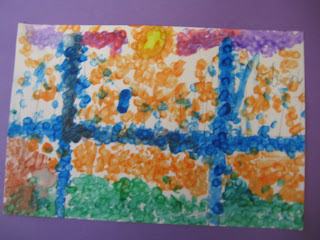
*A Catholic Schoolhouse Art Curriculum Activity.
Wednesday, February 22, 2012
Art, Week 17, Mary Cassat and Shading

d circles for them to shade. The students caught on very quickly, and even the less-motivated among them completed their cubes and circles before class was finished.
The main point they took away with them was that light shines in a direction, so the side closest to light will be brightest and the side farthest away from the light will be darkest. They were sent home to look for shadows and to draw objects this week using their new techniques.
*A Catholic Schoolhouse Art Curriculum Activity. Worksheets seen here were drawn by Mrs. Rolling.
*A Catholic Schoolhouse Art Curriculum Activity. Worksheets seen here were drawn by Mrs. Rolling.
Science, Week 17, Human Body
 This week students learned a bit of first aid. I began the class by asking them if they or any of their siblings had ever been to the emergency room. As expected, each family had at least one story to tell, and they all enjoyed telling their injury stories.
Then, we continued to talk about the types of injuries that can cared for at home if the right supplies are handy. The checklist given to students is based off one by the Boy Scouts of America. I explained each of the supplies in their first aid kits, and they assembled their own kits.
All first-aid supplies were bought at the local Dollar Tree or grocery store (butterfly-bandages). The plastic containers are just the right size for throwing into a back-pack for a hiking trip! Each student was very proud to have his name on the kit, too.
Wishing all students a Blessed Lent!
Alecia Rolling
Sunday, February 19, 2012
Art and Science, Week 16 with Catholic Schoolhouse Curriculum
 Art: Mary Cassatt and a Value Study
This week in art students began to learn about value, not of things, but of light and dark. They were given a black-line print of The Boating Party by Mary Cassatt and were allowed to choose one color to use for the entire print. Their task was to focus on the direction of light and what things would be dark and what things would be light. They seemed to jump on board!*
Science: The Human Body
We spent time exploring lung capacity this week using the CSH Science Curriculum; however, the activity seemed a bit too advanced for those students under 11 years of age. Since we only have a few who are older, it did not go over as well as it might have. The youngest students enjoyed being the "guinea pigs" of the older students, though!

Classroom Etiquette Note: Please remind students that they should remain quiet and respectful during instructions; otherwise, they waste time by asking questions during the experiment that need not be asked had they listened in the first place. This is most true for the older students.
Blessings on Saint Valentine's Feast!
Alecia Rolling
*Art: A CSH Art Curriculum Activity. Drawing on whiteboard made by Mrs. Rolling.
*Art: A CSH Art Curriculum Activity. Drawing on whiteboard made by Mrs. Rolling.
Saturday, February 11, 2012
Art, week 15 with Catholic Schoolhouse Curriculum
 This week the students learned about the horizon line and painted seascapes with water colors. They then made origami boats of different sizes to glue to their seascapes. This was a great opportunity to review perspective by putting the smaller boats farther up the paper than the larger boats. Winslow Homer's paintings have been a great inspiration in the use of color and perspective. The boys have especially enjoyed his more masculine style of painting and perception.
Monday, February 6, 2012
Second Quarter Quilt is finished!
 The students worked very hard to finish their 9-patch blocks before Christmas break. After some sewing on my part, we now have a finished quilt that the group plans to raffle off in the parish. We are hoping that the funds from this fundraiser will help with the expenses of field trips, supplies, and our end of the year program.
Sunday, January 29, 2012
Science, Week 14, The Human Body Continued
 This week we continued exploring the human body by observing our own bodies and looking for signs of the brain. Where is the brain? Can we see it? Well, if we cannot see it, how do we talk about it? We can begin to answer this question from a natural perspective by asking: "What do humans do?" The answers to this question are signs of the brain (and the Intellect which is more than the brain itself).
 One thing that humans can do is draw. Scientists throughout the centuries have used their own drawings to document animal and plant life, to sketch machines and inventions, and indeed to draw the human body. This week students caste themselves into this tradition and drew a human baby as an exercise for their brain, which they cannot see, but they can train.
Older students were sent home with a Nervous System worksheet and ideas for further exploration at home. The Nervous System Crossword Puzzle to take home (Answers are at this website!).
Want to learn more about the nervous system and the brain? Here is a nice website filled with activities! Neuroscience For Kids.
(Not a Catholic Schoolhouse Science Curriculum Activity.)
Friday, January 13, 2012
Art and Science, week 13
 Art: Snowmen and Winslow Homer
In art this week, students were finally allowed to pull out their water colors! They drew snowmen with pencils and colored them in with white crayons (a popular trick among children's art programs). Lastly, students painted with their water colors and behold! the snowmen were still white.
Painting is certainly a favorite activity for little ones and an activity that is harder to do at home sometimes, since it takes much work to cover the table, put on the aprons, etc. I am glad this is included in the CSH art curriculum!

Science: Review and Introduction of the Human Person
This week students reviewed the classification of animals that they had learned the first 6 weeks of Science. We added "Human" as way of introducing the third quarter to our students. The Bible verse in the CSH memory work "works" nicely for this poster along with the animal memory work from the first quarter. The cutting should be done by the tutor before the class for children ages 5-8. In retrospect I would recommend ONE poster PER FAMILY, since not all little ones can read. My 5 year-old would ask, what does "reptile" start with? Then, she looked for a word that started with "R" to put the lizard underneath it.
Please note that the activities this quarter are not part of the CSH Science curriculum.
Tuesday, December 6, 2011
Science, week 12 with Catholic Schoolhouse Curriculum
Extreme Weather. We had our weather grand finale today! Students pieced together 2-liter bottles to make water tornadoes, and we made lightening with balloons and a light bulb! Both were a great hit with the students. In retrospect, one balloon and a volunteer would have been more orderly than one balloon for each student. Imagine! 20 students each with a balloon in a small room! They enjoyed it.
Now we shall enjoy a long break to re-organize supplies and energies before we meet again in January. A Blessed Advent to all!
Alecia Rolling
*A CSH Science Curriculum Activity.
Now we shall enjoy a long break to re-organize supplies and energies before we meet again in January. A Blessed Advent to all!
Alecia Rolling
*A CSH Science Curriculum Activity.
Art, Week 12 with Catholic Schoolhouse Curriculum

This project developed by Mrs. Rolling.
Tuesday, November 29, 2011
Science, week 11 with Catholic Schoolhouse Curriculum
Science: More Wind Factors. This week we did an experiment to understand convection and its effect on wind. Below is a video of an experiment you can do at home or allow your students to watch (provided by Ward's Natural Science).
Art, week 11 with Catholic Schoolhouse Curriculum
 Art: Quilting. Several students returned this week with finished nine-patch blocks! They worked on reinforcing their seams to get rid of any holes while the rest of the class continued to work on their blocks. I have been most impressed by two of our younger students in the class (ages 4 1/2 and 5 1/2). They had almost finished their block before we left today, and they were sewing very nicely. Hopefully, this is encouragement for some of our older students.*
What is the benefit in sewing a nine-patch block? Firstly, the students have been so excited about this project because they realize this is not just an activity to keep them busy, but they are making a real thing, a blanket to be used by some child somewhere. They look at the seams in their clothes and realize they, too, can make clothes, socks, dresses for dolls, even priestly vestments! They are learning a real job. This means a great deal to young children (to learn to do adult things and to learn to build useful things), and this gift of the child should never be devalued, lest they stop wishing to become adults. To help them understand more fully the nature of their job, I recommend reminding your children that needles are tools and as such should be treated with special care. They would never play with Dad's chainsaw! The same rule applies to very small tools.
Secondly, the hand-eye coordination that is needed to sew helps the child with the virtues of patience and fortitude. This is a difficult task especially for our youngest students, and they must sit quietly and focus on their task if they wish to do well.
Finally, for those of you who prefer the mundane argument over one of idealism, sewing will also improve the fine motor skills needed for writing.
Completed 9-Patch Blocks are due next week.
God Bless Your Sewing this Week!
Alecia Rolling
Thursday, November 24, 2011
Art: Quilting Kits
 What is in our quilting kits?
- 9 pre-cut fabric squares
- large eye-hole hand needle
- fabric holder for needle
- 1 spool of thread (25 yards)
- instructions
All together for 24 students the cost came to $6!
*This project developed by Mrs. Rolling.
Friday, November 18, 2011
Art, week 10 with Catholic Schoolhouse Curriculum
 Art: Quilting Like the Pioneers. The next three weeks in art class, we will be working on a 9 Patch Block quilt. Each child received a quilting kit with instructions, and they were introduced today to sewing basics and to quilting. We discussed how the pioneers made their quilts from left over fabric and from old clothes. The children are sewing the quilt by hand just like the pioneers! This activity was a huge hit. All of the children worked very diligently and were excited to finish their blocks at home. Although I have set aside 3 weeks for quilting, I have a hunch most children will finish within two weeks! Here are some links to help you, parents, as you help your children:
- How to Sew By Hand
- How to stitch a 9 Patch Block
 Hooked on Needles: Disappearing 9 Patch blocks


*Art project developed by Mrs. Rolling.
See you next week!
Alecia Rolling
Subscribe to:
Posts (Atom)